
Index of Farmer's Market Online® Guides
Farm Kitchen
Breads
Chocolate
Coffee
Corn
Curry
Raisins
Spices and Culinary Herbs
Tea
Good Spirits & Fine Liqueurs
Bourbon
Brandy
Gin
Rum
Tequila
Vodka
Whiskey
Home & Garden
Candles
Dough Figurines
Wreaths
In Season
Air Plants
Aloe Vera
Artichoke
Asparagus
Basil
Blackberries
Blueberries
Blood Orange
Cabbage
Catnip
Cranberries
Egyptian Walking Onions
Figs
Garlic
Grapefruit
Kale
Kohlrabi
Pawpaw
Peaches
Pecans
Peppers
Pomegranates
Pumpkin
Shelling Beans
Sour Cherries
Meats & Fish
Turkey
Nuts & Grains
Chestnuts
Plants
Air Plants
Azaleas
Bigleaf Hydrangea
Bonsai
Bronze Dutch Clover
Camellia
Carnivorous Plants
Catnip
Chestnut
Christmas Cactus
Cranberry
Easter Lily
Gentian
Heuchera
Mint
Orchids
Ornamental Cabbage
Ornamental Grasses
Pasque Flower
Pawpaws
Pinyon Pine
Poinsettia
Roseroot
Salvia
Sneezeweed
Voodoo Lily
Zinnia
Specialty Foods
Spices
Dough Figurines
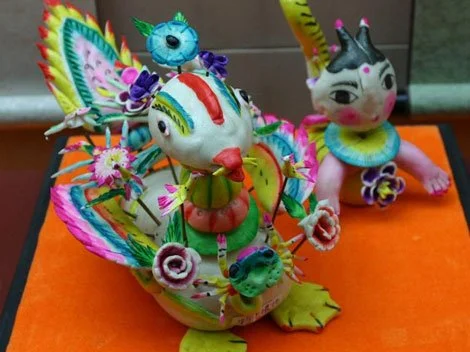
A 4,000-year-old Chinese folk art rarely practiced today, dough figurine is also known as mianhua or miansu in Chinese… Dough figurines have been present in Chinese culinary culture for a long time, appearing in Tang dynasty (618-907) tombs as sacrificial offerings
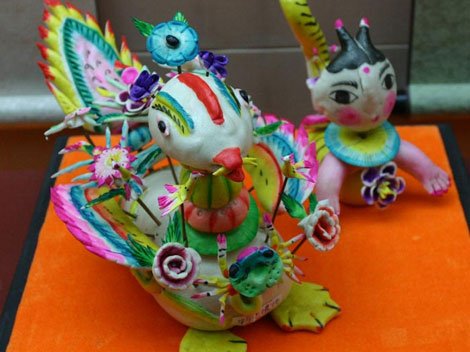
A 4,000-year-old Chinese folk art rarely practiced today, dough figurine is also known as mianhua or miansu in Chinese.
The man who may have created the craft, Zhuge Liang, was military strategist of the state of Shu in the Three Kingdoms era (220-280). According to a local legend, he once tried to organize a crossing of the Han River but the waves were so high that passage was impossible. Advisors recommended a sacrifice of 49 human heads to calm the waters. Not wanting to see any loss of life, Zhuge Liang ordered 49 dough heads made, stuffed with beef and horsemeat. The ploy successfully fooled the spirits responsible for the choppy waters and ever since then, Zhuge has been known as the father of dough-figurine making.
"Dough figurines have been present in Chinese culinary culture for a long time, appearing in Tang dynasty (618-907) tombs as sacrificial offerings," reports the Taiwan Journal. "In addition to serving food for human consumption, traditional Chinese banquets included a table of offerings to the gods, composed of flowers and figurines. After the feast, the decorations became toys for children or were thrown away."
In a 2008 article, the Taiwan Journal profiles 74-year-old Wu Chen Su, a contemporary dough figurine artist along with her son and husband. Their modest home is decorated with more than 150 collections of the figurines.
"The Wus got their first taste of dough-figurine making while operating the family bakery business. Whenever there were festivals, people would order cakes baked in various shapes, including pigs, fish or ducks, and leave them on the altars as sacrificial offerings to ancestors or deities. Wu Chun-te said that one year, his mother met a master dough-figurine maker who visited Changhua and made an offering with a dough pig he had sculpted. Fascinated by the realistic appearance of the porker, she convinced the master to teach her the secrets of the craft during his stay in their home. The man not only taught her how to take a ball of dough, squeeze it into shapes and then assemble them to create a figure, but he shared the recipe for making dough in the traditional manner using uncooked glutinous rice, flour, water and a pinch of salt as an antiseptic."
Wu Chun-te leads classes in dough figurines for students aged from 5 to 96 in high schools, community centers and reform schools. He's received invitations to demonstrate his skills in Japan, Poland, Paraguay, Russia and the United States flooding in. "We have received far more interest in dough-figurine making from abroad than I ever expected," he told the Taiwan Journal. "I genuinely believe that through traditional art, we can help more countries learn about Taiwan and build up social diplomacy."

