Index of Farmer's Market Online® Guides
Farm Kitchen
Breads
Chocolate
Coffee
Corn
Curry
Raisins
Spices and Culinary Herbs
Tea
Good Spirits & Fine Liqueurs
Bourbon
Brandy
Gin
Rum
Tequila
Vodka
Whiskey
Home & Garden
Candles
Dough Figurines
Wreaths
In Season
Air Plants
Aloe Vera
Artichoke
Asparagus
Basil
Blackberries
Blueberries
Blood Orange
Cabbage
Catnip
Cranberries
Egyptian Walking Onions
Figs
Garlic
Grapefruit
Kale
Kohlrabi
Pawpaw
Peaches
Pecans
Peppers
Pomegranates
Pumpkin
Shelling Beans
Sour Cherries
Meats & Fish
Turkey
Nuts & Grains
Chestnuts
Plants
Air Plants
Azaleas
Bigleaf Hydrangea
Bonsai
Bronze Dutch Clover
Camellia
Carnivorous Plants
Catnip
Chestnut
Christmas Cactus
Cranberry
Easter Lily
Gentian
Heuchera
Mint
Orchids
Ornamental Cabbage
Ornamental Grasses
Pasque Flower
Pawpaws
Pinyon Pine
Poinsettia
Roseroot
Salvia
Sneezeweed
Voodoo Lily
Zinnia
Specialty Foods
Spices
Chocolate
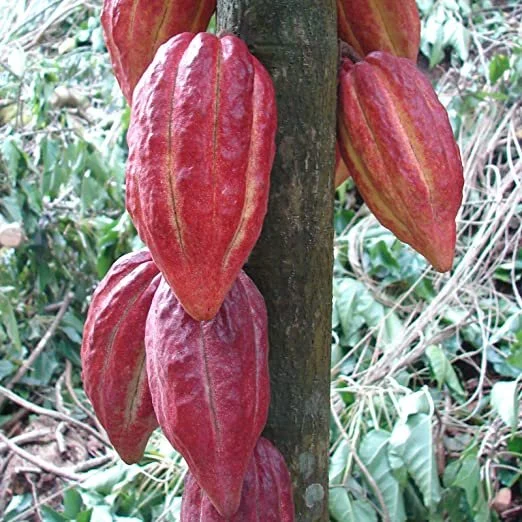
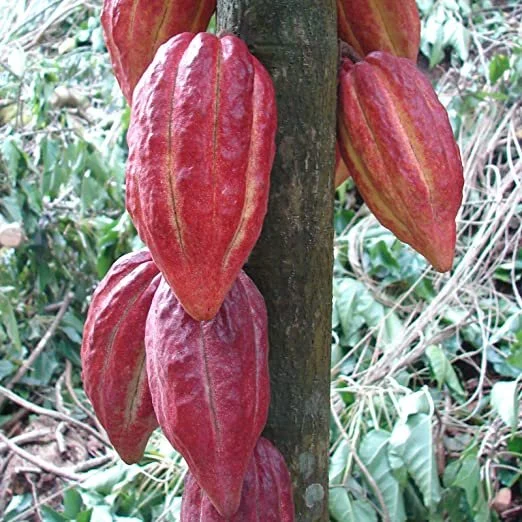
At five years of age, cacao trees start producing elongated, tapering red-yellow fruit about 18cm long and 8cm wide. A ribbed shell surrounds the pulp which envelopes from 30 to 50 little oval seeds arranged in tightly packed overlapping rows. Harvesting takes place twice a year, near the solstices, when the dry and rainy seasons begin.
Chocolate is made from seeds of the cacao tree, native to equatorial regions of the Americas.
Cacao grows only between the 22° parallel latitudes north and south of the equator, from 30 to 300 meters above sea level, and in temperatures ranging from 20 to 35°C. It requires abundant, well-distributed rain without damaging downpours, high humidity and deep fertile soil.
At five years of age, cacao trees start producing elongated, tapering red-yellow fruit about 18cm long and 8cm wide. A ribbed shell surrounds the pulp which envelopes from 30 to 50 little oval seeds arranged in tightly packed overlapping rows.
Harvesting takes place twice a year, near the solstices, when the dry and rainy seasons begin.
Chocolate Therapy
The size, shape and type of chocolate we choose can tell us a lot about ourselves. Whether it is dark chocolate or milk chocolate ... the choice reveals characteristics about your personality and how you deal with people.
This was demonstrated in a study by Murray Langham, a New Zealand psychotherapist and author of the book "Chocolate Therapy: Dare To Discover Your Inner Self."
Langham's study seeks to explain the correlation between our choices in chocolate, even how we dispose of the wrapper, and our personality.
Money Tree
The word chocolate comes from chocolatl-cacautl which in the language of Mexcian and Central American Indians means money, for these people used cacao beans as coins, a practice continued into the early 1900s... Thus, when Europeans first saw this plant in the 1500, they called it 'money tree.'
Cacautl was also the name ot the "bitter water," the hot, dark, dense beverage that by 600 BC both the Mayas ad Aztec Indians were making from their "coins." For them, the tree was of divine origin, from paradise, and the drink it produced was sacred. ~ Chocolate, Truffles, and other Treasures of Italy's Piedmont Cuisine
The Darker The Better
Dark chocolate is believed to provide multiple health benefits because of its high levels of flavonoids, which are antioxidants that protect cells from damage caused by free radicals. Free radicals are unstable molecules that can alter and weaken cells, according to the Cleveland Clinic. Research has found that flavanols, which are the main type of flavonoid found in cocoa and chocolate, have potential influences on vascular health, including lowering blood pressure, improving blood flow to the brain and heart, and making blood platelets less sticky and less likely to clot.
Milk chocolate doesn't provide the same health benefits. Generally speaking, dark chocolate has more cocoa than milk chocolate. Dark chocolate also has fewer unhealthy sugars and saturated fats than milk chocolate. Researchers at Harvard University Medical School suggest choosing chocolate that has at least 70% cocoa or more.