Pumpkin

A member of the gourd family, the pumpkin is native to the Western Hemisphere. Large, round and orange, the pumpkin has a mild sweet flavor with edible seeds. The seeds are commonly known as pepitas.
There is evidence that people in what is now Mexico were eating gourds as early as 5,500 BC, and when European settlers first arrived in North America, the Native Americans were growing pumpkins.
Season
Depending on the variety and the location, pumpkins are generally in season from September through March.
Selection
The traditional, basketball-sized, orange fruit is not the only choice in pumpkins any more.
“While orange is still the norm, the market offers white, bluish-gray, buff or even red pumpkins, too,” according to University of Georgia Cooperative Extension horticulturist Terry Kelley.
If you’re a traditionalist, Kelley recommends the deep burnt orange color of a Magic Lantern or the light orange of an Old Zeb's. If your goal is to carve a jack-o'-lantern, stay in the 8- to 20-pound range.
If you like trying something new and thinking outside the box, why not try a white or blue pumpkin?
The traditional Lumina variety is the standard white pumpkin that grows from 5 to 12 pounds. Cotton Candy is another of similar size.
If you're looking for a mini, Baby Boo is a small, white pumpkin. If you want to go toward the giant side, try Full Moon, one of the newest pumpkins on the market. It is a white-skinned variety that can easily grow to 80 pounds.
Jarrahdale is a grayish blue pumpkin that's deeply ribbed and somewhat flat. Despite its unique outside color, it's just as orange as any jack-o'-lantern on the inside. Most of the white varieties are orange on the inside, too.
Fairytale and Cinderella are flat, scalloped varieties with glossy skin in buckskin and deep orange. Red Eye is almost red and has veins of white running through the red background. One Too Many has the opposite color scheme.
Storage
Whole pumpkins (not cut and free of bruises) can last two months if stored in a dry, cool and airy location where they won't freeze or be exposed to insects or rodents.
Grow Your Own
Consult your favorite vegetable seed catalog and choose the pumpkin you would like to grow. Varieties range in size from 2 to 25 pounds. The usual days to maturity is 110 days but do not get in a hurry, the seeds do not germinate in cold soil, and the seedlings are injured by frost. Do not plant until all danger of frost has passed, and the soil has thoroughly warmed. Plant pumpkins for Halloween in late May, if pumpkins are planted too early, they may soften and rot before Halloween.
Growing a Giant Pumpkin
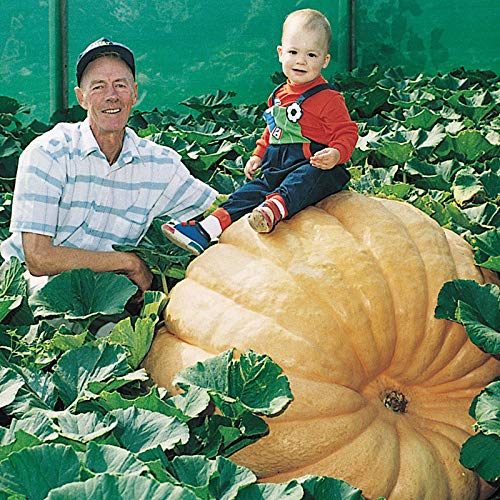
“If you want a behemoth, pick from one of the giant varieties like Dill's Atlantic Giant,” Kelley said. “Finding these fruits from 300 to 600 pounds is not uncommon. The world record is around 1,200 pounds.”
Harvesting a giant pumpkin, of course, begins with planting the right seeds. But the gardener can also help the process along by thinning out some of the pumpkins on each plant. Once the pumpkin has set fruit, look over the plant and find the largest two or three pumpkins on the vine that you will keep. Remove all the other smaller pumpkins and also pinch off any blossoms. Thinning the plant in this way will push the plant's growth energy into the few remaining pumpkins so that they can really grow. Maturing pumpkins also require more water, so be sure they are watered regularly, and especially on very hot days.
You don't have to stick with orange giants, either. White pumpkins and other varieties range in size from a bushel basket to a small automobile.
Decorative Pumpkins
For decorating, a plethora of miniature types come in all colors, too, from orange to white to mixed. Kelley says true miniature pumpkins weigh a pound or less.
Gold Dust and Jack-Be-Little are just two of the many miniature varieties that come in orange. Cannonball, Ironman and Li'l Ironsides grow in the 2- to 5-pound range.
There are still more varieties to choose from like the striped minis Li'l Pump-Ke-Mon and Hooligan.
What's in a Name?
The name "pumpkin" originated from the Greek word for "large melon," which is "pepon."
"Pepon" was nasalized by the French into "pompon."
The English changed "pompon" to "Pumpion."
Shakespeare referred to the "pumpion" in his "Merry Wives of Windsor." American colonists changed "pumpion" into "pumpkin."
The "pumpkin" is referred to in "The Legend of Sleepy Hollow," "Peter, Peter, Pumpkin Eater" and "Cinderella."
Pumpkins, squash and gourds are members of the vine crops called "cucurbits," which is derived from their botanical genus classification of Cucurbita.
Varieties of pumpkins, squash and gourds are popularly called "pumpkins," and varieties of each are called "squash."
So, what is a Pumpkin?
Pumpkins are a warm-season vine crop that can be grown throughout much of the United States. Besides being used as jack-o'-lanterns at Halloween, pumpkins are used to make pumpkin butter, pies, custard, bread, cookies and soup.
Native Americans dried strips of pumpkin and wove them into mats. They also roasted long strips of pumpkin on the open fire and ate them. The origin of pumpkin pie occurred when the colonists sliced off the pumpkin top, removed the seeds, and filled the insides with milk, spices and honey. The pumpkin was then baked in hot ashes.
A Vegetable, or a Fruit?
The pumpkin, like the tomato, is often called a vegetable - but is it? In the truest sense it is a fruit because a fruit is the ripened ovary - together with seeds - of a flowering plant. In many species, the fruit incorporates the ripened ovary and surrounding tissues as with the pumpkin. Fruits are the means by which flowering plants disseminate seeds.
Another interesting thing about pumpkins is they have both male and female flowers. That is why the first flowers of the pumpkin do not set fruit. They are the male flowers that attract the bees, usually bumblebees. The next wave of flowers are both male and female and the bees deposit the pollen in the female flowers and the fruit begins to grow.
Cooking Pumpkins
Pumpkins that are best for cooking will be small and heavy for their size, ranging from about five to seven pounds.
Pumpkins for cooking will often be marketed as pie pumpkins and will contain more pulp than the larger jack-o-lantern varieties. Choose a pumpkin that has at least a one inch stem firmly attached, and that is free from soft spots or damage. It should feel firm and have a consistent color.
Pumpkins lend themselves to a variety of cooking methods. It is possible to serve pumpkins as a side dish, soup, cake, muffin, bread, custard and even pie. Pumpkin can also be substituted for winter squash or sweet potatoes in recipes, and even the seeds can be toasted for healthy snacks.
Before using for food preparation, rinse and scrub the pumpkin clean. Once you cut the pumpkin open, you must cook it right away. Remove the seeds and stringy material; save the seeds for roasting. Then cut the flesh of the pumpkin into wedges or halves.
To boil: place the wedges or halves in a large pot with enough water to cover the pumpkin. Bring the water to a boil, cover, reduce heat and let simmer. Cook until you can pierce flesh easily with a fork. Drain and let cool. Peel the flesh from the skin.
Oven baking: place the pumpkin halves on a baking sheet and bake at 350°F for about 1 to 1.5 hours, or until flesh is tender when pierced with a fork. When cool enough to handle, scoop out the flesh.
The flesh of the cooked pumpkin can be mashed or pureed with a food processor or blender. A five pound pumpkin will yield about four cups of mashed, cooked pumpkin. Chill cooked pumpkin immediately.
Use cooked pumpkin within 36 hours or freeze at 0 degrees F for up to one year. Use rigid plastic containers leaving an inch headspace for expansion, or use freezer bags. Package in amounts that you will use for a recipe such as two cups for a pumpkin pie. Use puree in recipes or substitute in the same amount in any recipe calling for solid pack canned pumpkin.
To roast the seeds: Just wash the seeds in warm water, and spread them out to dry. Toss in a little oil or spray a shallow baking sheet with oil and spread the seeds in a single layer. Bake them at 250 degrees Fahrenheit for about 15-20 minutes, occasionally stirring. Salt if desired, cool and store.
Roasted pumpkin seeds make a terrific energy snack. They are a great source of protein, minerals, vitamins, and omega-3 fatty acids. Store roasted seeds in an airtight container in the refrigerator. If they are going to be kept longer than 10 to 14 days, place them in the freezer.
Nutrition
The color of the pumpkin offers a clue to its great nutritional value as an excellent source of carotenoids, including beta-carotene that the body converts into vitamin A.
A good supply of these disease preventing compounds are in as little as a half cup of cooked pumpkin, which contains only about 24 calories. This same amount supplies over 100 percent of your recommended daily intake of vitamin A, a good amount of vitamin C, fiber, and several health beneficial phytochemicals.
Pumpkin Facts
· Pumpkin seeds can be roasted as a snack.
· Pumpkins contain potassium and Vitamin A.
· Pumpkins are used for feed for animals.
· Pumpkin flowers are edible.
· Pumpkins are 90 percent water.
· Eighty percent of the pumpkin supply in the U.S. is available in October.